How to Turn Brand DNA into a Collection Concept (2026)
Turn brand DNA into a collection concept, step by step: design principles, a season hook, a concept board, and product-ready visuals.
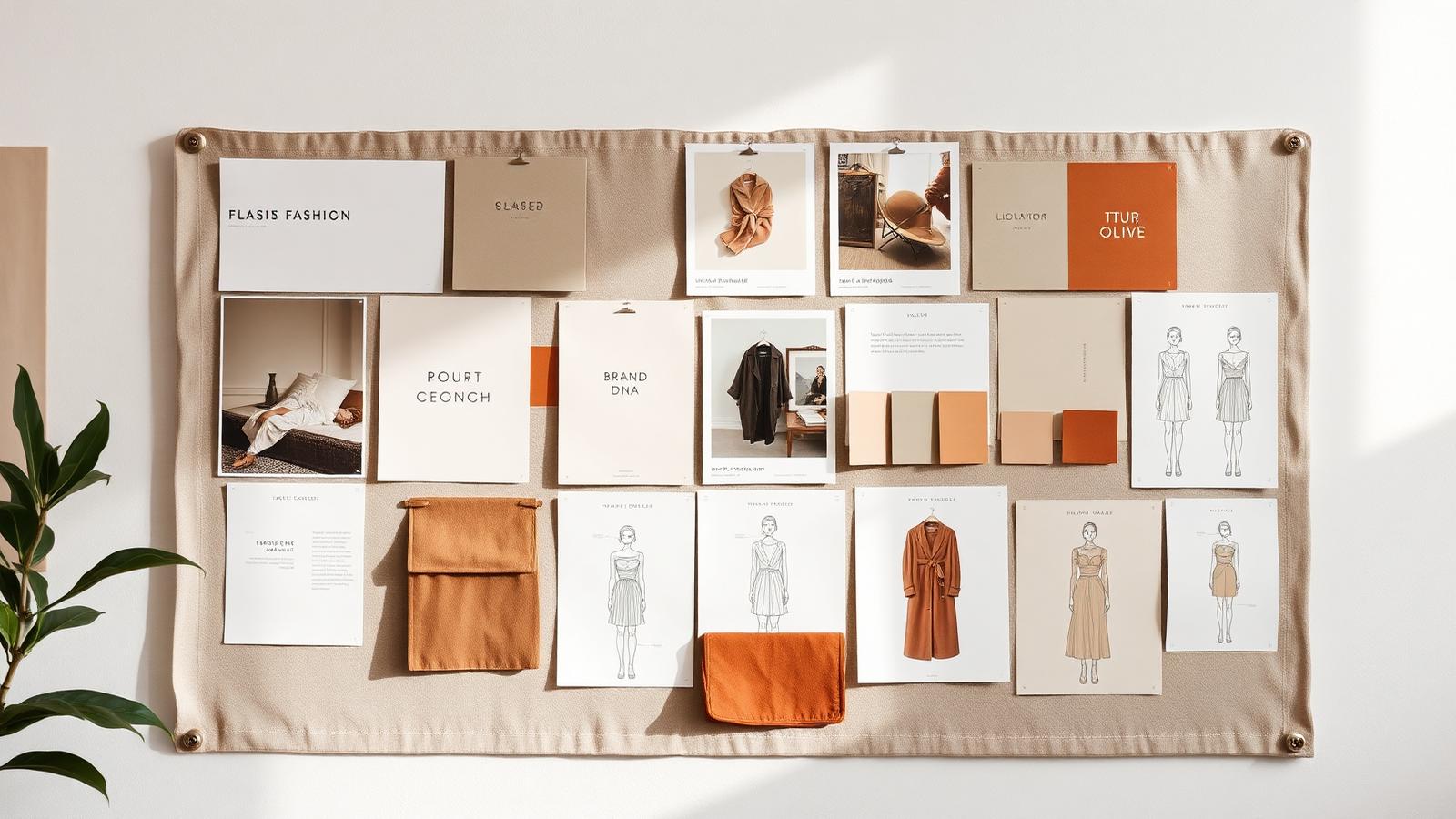
You can describe your brand in a sentence. You just cannot get a collection out of it. That gap, between what your brand stands for and what you put on the rack, is where most small fashion brands stall. The fix is a repeatable way to turn brand DNA into a collection concept, instead of starting every season from a blank moodboard.
Concept dies on a moodboard. The brands that ship turn brand DNA into product-ready visuals. This guide gives you the framework: what brand DNA is, how to translate it into a concept that designers can build, the decisions a human keeps, and how to run the whole thing on one canvas.
Table of Contents
- TL;DR: Brand DNA to concept in five lines
- What is brand DNA?
- What is a collection concept?
- Why brand DNA rarely becomes a real collection
- The 6 stages from brand DNA to collection concept
- What AI should not decide about your concept
- Brand DNA to concept: the old way vs a connected way
- How to start: a first-concept workflow
- Common mistakes turning DNA into a collection
- What to look for in a concept tool
- How a strong concept affects your season
- How Kampana turns brand DNA into a collection concept
- FAQ
- The bottom line
TL;DR: Brand DNA to concept in five lines
- Brand DNA is the irreducible core of what your brand is, believes, and how it expresses itself: values, character, tone, and visual codes (Maker's Row).
- A collection concept is the bridge from that DNA to a buildable season: a hook, a palette, silhouettes, and reference visuals designers can work from.
- Translate DNA into a short list of design principles first. Do not jump from values straight to sketches.
- The work that gets shipped turns the concept board into product-ready visuals, not just a wall of inspiration.
- AI can generate and vary the concept. The brand judgment, the edit, and the final say stay human. Map it to Kampana's collection concept from brand DNA workflow.
What is brand DNA?
Brand DNA is the core identity of your brand: the values, character, tone of voice, and visual codes that make it recognizable and distinct from everyone else (Maker's Row). Some people call it brand essence or brand identity. It is the genetic code that should shape every decision, from design to pricing to how you talk to a customer.
For a fashion brand specifically, DNA is what keeps a collection feeling like you across seasons even as the styles change (Digital Fashion Academy). It is the reason a customer can spot your piece without seeing the label.
Brand DNA usually has a few parts:
| Part | What it captures | Example |
|---|---|---|
| Values | What the brand believes | Quiet durability over trend |
| Customer | Who it is for | The design-literate 30-something who buys less |
| Character | The brand's personality | Calm, exacting, unfussy |
| Visual codes | Recurring design signatures | Tonal palettes, clean seams, natural fibers |
| Tone | How it speaks | Plain, confident, no hype |
If you cannot fill that table, your DNA is a vibe, not a tool. The whole point of writing it down is that it becomes something you can design against.
What is a collection concept?
A collection concept is the translation layer between your brand DNA and a season you can actually build. DNA is permanent. A concept is per-season. It takes the fixed identity and gives this season a hook, a palette, a set of silhouettes, and reference visuals.
Think of DNA as the constitution and the concept as the season's law. The constitution does not change every six months. The law adapts to the moment while staying inside the constitution.
A complete concept gives a designer four things to work from:
- A hook. The one idea this season explores within the brand.
- A palette. The season's colors, drawn from the brand's codes.
- Silhouettes. The shapes and categories the season favors.
- Reference visuals. Product-level images that show, not tell.
A concept that stops at a moodboard gives a designer a feeling. A concept that ends in product-ready visuals gives them a starting point. That difference is the whole game. See how this feeds seasonal collection planning once the concept is set.
Why brand DNA rarely becomes a real collection
Most brands have DNA. Few have a way to turn it into product. The breakdown is almost always one of these.
The DNA lives in a founder's head, never written down, so every season starts from instinct and nobody else can design to it. Or it is written but treated as a marketing artifact, framed on a wall and ignored at the design desk.
When the translation does happen, it usually stalls on a moodboard. A wall of pretty references is not a concept. It is a feeling without a shape. A designer cannot cut a garment from a mood.
Four reasons DNA never becomes a collection:
- Unwritten DNA. It cannot be designed against if it only exists as taste.
- Moodboard dead-end. Inspiration that never becomes a product-level visual.
- No season hook. Without a per-season idea, every collection is a slightly different version of the last.
- The translation is slow. Going from references to product visuals by hand takes weeks, so it gets skipped.
Your concept investment should not stop at a moodboard. The brands that ship are the ones that carry it all the way to product-ready visuals.
The 6 stages from brand DNA to collection concept
Here is the repeatable framework. Each stage hands the next something concrete. Run them in order.
Stage 1: Write down your brand DNA
Fill the DNA card from the section above: values, customer, character, visual codes, tone. Keep it to one page. The test is whether someone who is not you could design a recognizable piece from it.
If your DNA only exists as instinct, this stage is the highest-leverage hour you will spend all season. Everything downstream borrows from it.
Stage 2: Translate DNA into design principles
Turn the abstract DNA into a short list of design rules. Principles are specific and testable, where values are not.
Example translation:
| DNA value | Design principle |
|---|---|
| Quiet durability | Natural fibers, reinforced seams, no logos |
| Buy less | Carryover-friendly shapes, season-spanning colors |
| Calm character | Tonal palettes, minimal hardware |
Now a designer has something to obey. "Calm" is a feeling. "Tonal palettes, minimal hardware" is a constraint they can cut to.
Stage 3: Set the season's hook
Pick the one idea this season explores. It has to live inside the DNA, not next to it. A "quiet durability" brand might run a season on "workwear softened," or "the uniform, rebuilt." One line. Specific enough to exclude things.
The hook is what makes this season different from the last while keeping it unmistakably yours. Without it, you get carryover with a new color and call it a collection.
Stage 4: Build the concept board
Now gather references against the hook and the principles, not against your general taste. Pull palette, silhouette, fabric, and detail references that serve this specific season.
This is the moodboard stage, but with a job. Every reference earns its place by answering the hook. If a reference is beautiful but off-hook, it goes. For the tooling side of this, see how to build a fashion moodboard that leads to production.
Stage 5: Turn the board into product-ready visuals
This is the stage most brands skip, and it is the one that matters. Take the concept board and generate actual product-level visuals: silhouettes in the season palette, on body or as flats, that a designer and a buyer can react to.
A reference says "something like this." A product-ready visual says "this." It moves the conversation from interpretation to decision. This is where a node-based canvas earns its keep, because you can generate variations of a silhouette in the season's colors and keep the ones that hold the DNA. From here the concept can flow straight into a technical design assist pack.
Stage 6: Edit against the DNA
Generation gives you options. The concept is the edit. Lay the product visuals next to the DNA card and the hook, and cut anything that drifts. Keep the few that are unmistakably the brand and clearly this season.
The edit is a human call. A tool can give you forty silhouettes. Only you know which five are you. End the stage with an approved concept: a hook, a palette, a silhouette set, and the chosen product visuals, ready to brief a season.
What AI should not decide about your concept
AI is genuinely useful in this process. It is fast at the parts that are slow by hand: generating variations, recoloring silhouettes into a palette, and turning references into product-level visuals so you can react to something real.
It is not useful as the decision-maker. The judgment stays with you.
What a human keeps:
- The DNA itself. A model cannot author what your brand believes.
- The hook. Which idea is worth a season is a brand call.
- The edit. Which visuals are "us" and which are merely good.
- The line you will not cross. The detail that would be off-brand even if it sells.
AI will not replace the person who holds the brand. It gives them a starting pack so they edit instead of start from nothing. Kampana keeps a human approval gate on the concept for exactly this reason. The machine proposes. You decide.
Brand DNA to concept: the old way vs a connected way
The old way scatters the work across tools that never talk. The DNA is in a deck, the references in a Pinterest board, the visuals in a designer's files, the plan in a spreadsheet. Nothing connects, so the concept restarts from scratch every season.
| Old way (scattered) | Connected (one canvas) | |
|---|---|---|
| Brand DNA | A deck nobody opens | A reusable input node |
| References | Pinterest board, off to the side | On the canvas, tied to the hook |
| Product visuals | Skipped or outsourced, slow | Generated and edited in place |
| Concept-to-plan | Re-keyed by hand | Flows into the line plan |
| Reuse next season | Start over | DNA and codes reused |
| Approvals | Scattered feedback | One approval gate |
The connected approach does not invent your concept. It removes the rework so the only thing you spend time on is the brand judgment. Compare the full set on the Kampana workflows hub.
How to start: a first-concept workflow
You can run this for your next season in an afternoon.
- Write the DNA card. Values, customer, character, visual codes, tone. One page.
- Translate to principles. Turn each value into a testable design rule.
- Set the hook. One line, inside the DNA, specific enough to exclude.
- Build the concept board against the hook, not your general taste.
- Generate product-ready visuals from the board in the season palette.
- Edit against the DNA and approve a final concept.
- Hand it to planning and design as a brief with a hook, palette, silhouettes, and visuals.
Run it once and you will stop starting seasons from a blank page. To do steps 4 through 7 on a shared canvas, start with the collection concept from brand DNA workflow.
Common mistakes turning DNA into a collection
Leaving DNA unwritten
The fix: write the one-page DNA card before anything else. Unwritten DNA cannot be designed against, delegated, or kept consistent (Maker's Row). It has to leave your head.
Stopping at the moodboard
The fix: carry the concept to product-ready visuals. A moodboard is an input, not a concept. The brands that ship turn references into product-level images a designer and a buyer can decide on.
Skipping the season hook
The fix: commit to one hook per season, inside the DNA. Without it, every collection is a near-copy of the last with a new palette. The hook is what makes a season worth doing.
Letting the concept drift from the brand
The fix: edit every visual against the DNA card. Generation is cheap, so the discipline moves to the edit. Keep only what is unmistakably you (Digital Fashion Academy).
What to look for in a concept tool
If you are choosing software to run concept development, judge it on whether it closes the gap from DNA to product.
- Reusable brand inputs. Your DNA and visual codes should be saved and reused, not re-entered each season.
- References tied to a hook. The board should serve the season, not float as general inspiration.
- Product-level generation. It should produce silhouettes in your palette, not just collages.
- Variation and edit. Generate many, keep few, on the same surface.
- An approval gate. A human signs off on the concept before it briefs a season.
- A path to production. The concept should flow into the line plan and tech packs, not dead-end.
A tool that only makes prettier moodboards has not closed the gap. One that turns DNA into product-ready visuals has. See how it prices on Kampana pricing.
How a strong concept affects your season
A concept is not a creative luxury. It is the thing that makes the rest of the season faster, cheaper, and more consistent.
A clear concept speeds design. A designer who gets a hook, a palette, silhouettes, and reference visuals starts from a brief instead of a blank page. The first samples come back closer to right, which means fewer rounds and less time lost.
A clear concept protects the brand. When every style traces back to a written DNA and a season hook, the collection holds together. The customer who can recognize your piece without the label is the customer a strong concept earns. That recognition is what keeps a brand from blending into the feed.
And a concept that ends in product-ready visuals shortens the whole runway to a sellable season. The visuals you generate for the concept can seed the line plan, the tech packs, and even early PDP and sell-in assets. The work compounds instead of restarting. See how the full path runs in the end-to-end collection launch.
How Kampana turns brand DNA into a collection concept
Kampana is an AI product creation OS for fashion brands. It turns one product into design, 3D renders, tech packs, PDP imagery, B2B sell-in kits, marketplace feeds, and social campaigns, on a node-based canvas with approval gates and product-fidelity QA. The concept is where a season starts, and Kampana is built so it does not stop at a moodboard.
You save your brand DNA once, then generate and edit a concept against it on the canvas, with a human approval gate before anything briefs a season.
What you get
- A reusable brand DNA input you set once and pull into every season.
- A concept board tied to the season hook, not floating inspiration.
- Product-ready visuals generated in the season palette, not just collages.
- Variation and edit on one surface: generate many, keep the few that are you.
- A human approval gate on the concept before it briefs design.
- A clean handoff into seasonal planning and technical design assist packs.
The old way vs Kampana
| Old way | With Kampana | |
|---|---|---|
| Brand DNA | Deck nobody reopens | Reusable input node |
| References | Off-platform board | On canvas, tied to the hook |
| Product visuals | Skipped or slow | Generated and edited in place |
| Concept to plan | Re-keyed by hand | Flows into the line plan |
| Brand consistency | Drifts season to season | Edited against saved DNA |
| Approvals | Scattered | One approval gate, product-fidelity QA |
How it works
- Save your brand DNA as an input on the canvas.
- Set the season hook and build the concept board against it.
- Generate product-ready visuals in the season palette.
- Vary the silhouettes and keep the few that hold the DNA.
- Approve the concept at the human gate.
- Hand the locked concept to planning, design, and the rest of the end-to-end launch.
Pricing is credit-based. You draw from one shared credit pool, with no seats and no subscription, and credits do not expire. There is a free starter pack to build your first concept, and concept generation draws a credit range that scales with how many visuals you generate. See current ranges on Kampana pricing.
Concept dies on a moodboard. On Kampana it becomes product-ready visuals, with the brand judgment kept where it belongs: with you.
FAQ
What is brand DNA in fashion?
Brand DNA is the core identity of a fashion brand: its values, customer, character, tone, and recurring visual codes (Maker's Row). It is what keeps a brand recognizable across seasons even as the individual styles change.
What is the difference between brand DNA and a collection concept?
Brand DNA is permanent and brand-wide. A collection concept is per-season: it takes the fixed DNA and gives one season a hook, a palette, silhouettes, and reference visuals. DNA is the constitution; the concept is the season's law.
How do I turn my brand DNA into a collection?
Write the DNA down, translate it into testable design principles, set one season hook inside it, build a concept board against that hook, generate product-ready visuals, then edit against the DNA. The full framework is in the stages above.
Why does a moodboard fail as a concept?
A moodboard is a feeling, not a shape. A designer cannot cut a garment from inspiration alone. A concept has to carry through to product-level visuals that show a specific silhouette in a specific palette, which is the part most brands skip.
Can AI generate a collection concept?
AI can generate references, recolor silhouettes into a palette, and turn a board into product-ready visuals quickly. It should not author your DNA, pick the season hook, or make the final edit. Those are brand judgments, and Kampana keeps a human approval gate on the concept.
How do I keep concepts consistent with my brand over time?
Write a one-page DNA card and edit every season's concept against it (Digital Fashion Academy). On a connected canvas, the DNA is a saved input you reuse, so consistency is built in instead of remembered.
Where does the concept go after it is approved?
A locked concept becomes the brief for seasonal planning, design, and tech packs. On Kampana the concept visuals are objects on the same canvas, so they flow straight into the line plan and a technical design assist pack.
How long does it take to build a concept this way?
The framework runs in an afternoon for a small brand once the DNA is written. Generating product-ready visuals on a canvas removes the slowest part, which is turning references into product-level images by hand. The edit is the part you should still spend real time on.
The bottom line
Every brand has DNA. The ones that ship have a way to turn it into a concept and the concept into product.
Write the DNA down. Translate it into design principles. Set one season hook. Build the board against the hook, then carry it all the way to product-ready visuals. Edit against the DNA and approve the concept.
Do that and you stop starting seasons from a blank moodboard. The concept becomes a brief, and the brief becomes a season that still looks like you. Ready to build yours on one canvas? Turn your brand DNA into a collection concept with Kampana or start creating for free.
Send one product URL. Kampana turns it into a mini campaign pack.